How Did Lorenzo Save the Family From Disaster That August on the Road to Florence
| Florentine Republic Repubblica Fiorentina | |||||||||||||||||
|---|---|---|---|---|---|---|---|---|---|---|---|---|---|---|---|---|---|
| 1115–1569 | |||||||||||||||||
| Top: State flag Coat of arms used by Ghibellines until 1251 Glaze of artillery adopted by Guelphs in 1251 | |||||||||||||||||
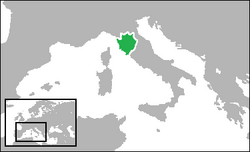 The Florentine Republic in 1548 | |||||||||||||||||
| Condition | Republic | ||||||||||||||||
| Majuscule | Florence 43°47′North 11°15′E / 43.783°N xi.250°E / 43.783; 11.250 Coordinates: 43°47′Northward 11°15′East / 43.783°North 11.250°E / 43.783; 11.250 | ||||||||||||||||
| Common languages | Italian | ||||||||||||||||
| Religion | Roman Catholicism | ||||||||||||||||
| Demonym(s) | Florentine | ||||||||||||||||
| Regime | Oligarchic commonwealth (1115–1494; 1498–1532) Republic nether a theocratic regime (1494–98) | ||||||||||||||||
| Gonfaloniere of Justice | |||||||||||||||||
| • 1293–1295 | Giano della Bella (starting time) | ||||||||||||||||
| • 1434-1464 | Cosimo de' Medici (first de facto Lord of Florence) | ||||||||||||||||
| • 1530–1532 | Alessandro de' Medici (terminal) | ||||||||||||||||
| Duke of the Florentine Republic | |||||||||||||||||
| • 1532–1537 | Alessandro | ||||||||||||||||
| • 1537–1569 | Cosimo I | ||||||||||||||||
| Legislature | Priorato delle Arti | ||||||||||||||||
| • Upper firm | Council of Ancients | ||||||||||||||||
| • Lower house | Quango of Consuls | ||||||||||||||||
| History | |||||||||||||||||
| • Commencement established | 1115 | ||||||||||||||||
| • Marquisate restored past Imperial forcefulness | 1185–1197 | ||||||||||||||||
| • Ciompi Revolt | 1378 | ||||||||||||||||
| • Incorporation of Pisa | 1406 | ||||||||||||||||
| • Founding of the | 1434 | ||||||||||||||||
| • Title of Duke of the Florentine Democracy created | 1554 | ||||||||||||||||
| • Occupation of Siena | 1555 | ||||||||||||||||
| • Elevated to Thou Duchy of Tuscany | 1569 | ||||||||||||||||
| Currency | Florin (from 1252) | ||||||||||||||||
| |||||||||||||||||
| Today office of | Italy | ||||||||||||||||




The Republic of Florence, officially the Florentine Republic (Italian: Repubblica Fiorentina, pronounced [reˈpubblika fjorenˈtiːna], or Repubblica di Firenze ), was a medieval and early modern country that was centered on the Italian city of Florence in Tuscany.[one] [2] The republic originated in 1115, when the Florentine people rebelled against the Margraviate of Tuscany upon the death of Matilda of Tuscany, who controlled vast territories that included Florence. The Florentines formed a commune in her successors' identify.[3] The republic was ruled by a council known equally the Signoria of Florence. The signoria was chosen by the gonfaloniere (titular ruler of the urban center), who was elected every two months by Florentine guild members.
During the Democracy'south history, Florence was an important cultural, economic, political and artistic strength in Europe. Its coin, the florin, became a world monetary standard.[iv] During the Republican period, Florence was also the birthplace of the Renaissance, which is considered a fervent period of European cultural, creative, political and economical "rebirth".[five]
The republic had a checkered history of coups and counter-coups confronting various factions. The Medici faction gained governance of the city in 1434 under Cosimo de' Medici. The Medici kept control of Florence until 1494. Giovanni de' Medici (later Pope Leo X) re-conquered the republic in 1512.
Florence repudiated Medici authority for a second fourth dimension in 1527, during the War of the League of Cognac. The Medici re-assumed their rule in 1531 subsequently an 11-month siege of the city, aided by Emperor Charles V.[six] Pope Clement 7, himself a Medici, appointed his relative Alessandro de' Medici every bit the first "Duke of the Florentine Republic", thereby transforming the Republic into a hereditary monarchy.[6] [7]
The second Knuckles, Cosimo I, established a strong Florentine navy and expanded his territory, conquering Siena. In 1569, the Pope declared Cosimo the first Thousand Knuckles of Tuscany. The Medici ruled the Grand Duchy of Tuscany until 1737.
Background [edit]

Italia in 1084, showing the Marquisate of Tuscany.
The city of Florence was established in 59 BC past Julius Caesar. Since 846 Advertisement, the city had been part of the Marquisate of Tuscany. After the female person ruler of the marquisate, Matilda of Tuscany, died in 1115, the metropolis did non submit readily to her successor Rabodo (r. 1116–1119), who was killed in a dispute with the city.
It is non known precisely when Florence formed its own republican/oligarchical government contained of the marquisate, although the death of Rabodo in 1119 should be a turning point. The first official mention of the Florentine democracy was in 1138, when several cities effectually Tuscany formed a league against Henry Ten of Bavaria. The country was nominally office of the Holy Roman Empire.[iii]
Co-ordinate to a report carried out by Enrico Faini of the Academy of Florence,[viii] there were about 15 former aristocratic families who moved to Florence between 1000 and 1100: Amidei; Ardinghi; Brunelleschi; Buondelmonti; Caponsacchi; Donati; Fifanti; Gherardini of Montagliari; Guidi; Nerli; Porcelli; Sacchetti; Scolari; Uberti; and Visdomini.
History [edit]
12th century [edit]
The newly independent Florence prospered in the 12th century through all-encompassing trade with foreign countries. This, in plow, provided a platform for the demographic growth of the city, which mirrored the charge per unit of structure of churches and palazzi. This prosperity was shattered when Emperor Frederick I Barbarossa invaded the Italian peninsula in 1185. As a result, the margraves of Tuscany re-acquired Florence and its townlands. The Florentines re-asserted their independence when Holy Roman Emperor Henry 6 died in 1197.[3]
13th century [edit]
Florence's population continued to grow into the 13th century, reaching a level of xxx,000 inhabitants. As has been said, the actress inhabitants supported the urban center'south trade and vice versa. Several new bridges and churches were built, most prominently the cathedral of Santa Maria del Fiore, begun in 1294. The buildings from this era serve as Florence'southward best examples of Gothic Architecture. Politically, Florence was barely able to maintain peace betwixt its competing factions. The precarious peace that existed at the beginning of the century was destroyed in 1216 when two factions, known equally the Guelphs and the Ghibellines, began to war. The Ghibellines were supporters of the noble rulers of Florence, whereas the Guelphs were populists.
The Ghibellines, who had ruled the city nether Frederick of Antioch since 1244, were deposed in 1250 by the Guelphs. The Guelphs led Florence to prosper further. Their primarily mercantile orientation soon became evident in one of their primeval achievements: the introduction of a new coin, the florin, in 1252. It was widely used beyond Florence's borders due to its reliable, stock-still gold content and before long became one of the common currencies of Europe and the Virtually East. The aforementioned year saw the cosmos of the Palazzo del Popolo.[9] The Guelphs lost the reins of power after Florence suffered a catastrophic defeat at the Battle of Montaperti against Siena in 1260. The Ghibellines resumed power and undid many of the advances of the Guelphs, for instance the demolition of hundreds of towers, homes, and palaces. The fragility of their rule caused the Ghibellines to seek out an arbitrator in the grade of Pope Clement 4, who openly favoured the Guelphs, and restored them to power.
The Florentine economy reached a zenith in the latter half of the 13th century, and its success was reflected by the building of the famed Palazzo della Signoria, designed by Arnolfo di Cambio. The Florentine townlands were divided into administrative districts in 1292. In 1293, the Ordinances of Justice were enacted, which effectively became the constitution of the republic of Florence throughout the Italian Renaissance.[x] The city'southward numerous luxurious palazzi were becoming surrounded by townhouses built by the e'er prospering merchant class.[3] In 1298, the Bonsignori family of Siena, ane of the leading cyberbanking families of Europe, went bankrupt, and the city of Siena lost its status equally the most prominent banking center of Europe to Florence.[11]
14th century [edit]
In 1304, the war between the Ghibellines and the Guelphs led to a keen fire which destroyed much of the city. Napier gives the post-obit account:
Battles beginning began between the Cerchi and Giugni at their houses in the Via del Garbo; they fought mean solar day and nighttime, and with the assist of the Cavalcanti and Antellesi the former subdued all that quarter: a thousand rural adherents strengthened their bands, and that solar day might have seen the Neri's destruction if an unforeseen disaster had not turned the scale. A certain dissolute priest, called Neri Abati, prior of San Piero Scheraggio, false to his family and in concert with the Blackness chiefs, consented to set fire to the dwellings of his own kinsmen in Orto-san-Michele; the flames, assisted past faction, spread rapidly over the richest and nigh crowded part of Florence: shops, warehouses, towers, private dwellings and palaces, from the quondam to the new market-place, from Vacchereccia to Porta Santa Maria and the Ponte Vecchio, all was one broad sheet of fire: more than nineteen hundred houses were consumed; plunder and devastation revelled unchecked among the flames, whole races were reduced in one moment to abjection, and vast magazines of the richest merchandise were destroyed. The Cavalcanti, one of the most opulent families in Florence, beheld their whole property consumed, and lost all backbone; they made no attempt to save it, and, after nearly gaining possession of the metropolis, were finally overcome past the contrary faction.

Front and back of a Florentine florin
The golden florin of the Republic of Florence was the starting time European aureate coin struck in sufficient quantities to play a meaning commercial role since the 7th century. As many Florentine banks were international companies with branches across Europe, the florin quickly became the ascendant trade coin of Western Europe for large scale transactions, replacing argent bars in multiples of the mark (a weight unit of measurement equal to eight ounces).
In fact, with the collapse of the Bonsignori family unit, several new banking families sprang upwardly in Florence: the Bardis, Peruzzis and the Acciaioli.[11] The friction between the Guelphs and the Ghibellines did not cease, authority however passed between the two frequently.
Florence'south reign as the foremost cyberbanking city of Europe did not last long; the aforesaid families were bankrupt in 1340, non because of Edward 3 of England's refusal to pay his debts, every bit is oftentimes stated (the debt was merely £13,000) but because of a Europe-broad economic recession. While the banks perished, Florentine literature flourished, and Florence was home to some of the greatest writers in Italian history: Dante, Petrarch and Boccaccio. They were Europe'due south first vernacular writers, choosing the Tuscan dialect of Italian (which, as a outcome, evolved into the standard Italian linguistic communication) over Latin.[12]
Florence was hit hard by the Black Decease. Having originated in the Orient, the plague arrived in Messina in 1347. The plague devastated Europe, robbing it of an estimated i/iii of its population.[xiii] This, combined with the economic downturn, took its price on the metropolis-state. The ensuing collapse of the feudal arrangement changed the social limerick of Europe forever; it was one of the kickoff steps out of the Eye Ages.

The growth of Florence from 1300 to 1500
The state of war with Avignon papacy strained the regime. In 1378 discontented wool workers revolted. The Ciompi defection, as information technology is known, established a revolutionary commune. In 1382 the wealthier classes crushed the seeds of rebellion.[fourteen]
The famous Medici bank was established by Giovanni di Bicci de' Medici in October 1397.[15] The bank continued to exist (albeit in an extremely diminished form) until the time of Ferdinando 2 de'Medici in the 17th century.[16] Simply, for now, Giovanni's bank flourished.
Get-go in 1389, Gian Galeazzo Visconti of Milan expanded his rule into the Veneto, Piedmont, Emilia and Tuscany. During this menstruum Florence, under the leadership of Maso degli Albizzi and Niccolò da Uzzano was involved in 3 wars with Milan (1390–92, 1397–98, 1400–02). The Florentine army, commanded by John Hawkwood, contained the Milanese during the first war.[17] The second war started in March 1397. Milanese troops devastated the Florentine contado, but were checked in August of that year.
The state of war expenses exceeded one million florins and necessitated tax raises and forced loans. A peace agreement in May 1398 was brokered by Venice, simply left the struggle unresolved.[18] Over the side by side two years Florentine control of Tuscany and Umbria collapsed. Pisa and Siena also equally a number of smaller cities submitted to Gian Galeazzo, while Lucca withdrew from the anti-Visconti league, with Bologna remaining the only major ally. In November 1400 a conspiracy involving both exiles and internal opponents was uncovered. Two Ricci were implicated as leaders of a plot to eliminate the regime'south inner circle and open up the gates to the Milanese. Confessions indicated that the plan had wide support among the elites, including a Medici and several of the Alberti.[18]
The democracy bankrolled the emperor-elect Rupert. However, he was defeated by the Milanese in the fall of 1401. Visconti then turned to Bologna. On June 26, 1402, combined Bolognese-Florentine forces were routed at Casalecchio, almost Bologna, which was taken on the 30th. The road to Tuscany was open. However, Florence was saved after an outbreak of plague had spread from Tuscany to Emilia and Lombardy: Gian Galeazzo died from it on 3 September 1402.[17] [18]
15th century [edit]

The Italian Peninsula in 1499.
The Visconti domains were divided between three heirs. Gabriele Maria Visconti sold Pisa to the Republic of Florence for 200,000 florins. Since the Pisans did non intend to voluntarily submit to their long-fourth dimension rivals, the regular army under Maso degli Albizzi took Pisa on 9 Oct 1406 afterwards a long siege, that was accompanied by numerous atrocities.[17]
The state authorities had been approached by the Duchy of Milan in 1422, with a treaty, that prohibited Florence'due south interference with Milan's impending war with the Republic of Genoa.[19]Florence obliged, but Milan disregarded its own treaty and occupied a Florentine edge boondocks. The conservative government wanted war, while the people bemoaned such a stance as they would exist bailiwick to enormous revenue enhancement increases. The democracy went to war with Milan, and won, upon the Republic of Venice's entry on their side. The war was concluded in 1427, and the Visconti of Milan were forced to sign an unfavourable treaty.
The debt incurred during the war was gargantuan, approximately 4,200,000 florins.[twenty] To pay, the land had to alter the tax system. The current estimo system was replaced with the catasto. The catasto was based on a citizen'south entire wealth, while the estimo was simply a grade of income tax. Autonomously from state of war, Filippo Brunelleschi created the renowned dome of the Santa Maria del Fiore, which astounded contemporaries and modern observers akin.
Medicis' Rule [edit]

Glaze of artillery of the House of Medici
The son of Giovanni di Bicci de' Medici, Cosimo de' Medici succeeded his father equally the head of the Medici Bank. He played a prominent role in the government of Florence until his exile in 1433, after a disastrous war with Tuscany's neighbour, the Republic of Lucca.[twenty] Cosimo'south exile in Venice lasted for less than a twelvemonth, when the people of Florence overturned Cosimo's exile in a autonomous vote. Cosimo returned to the acclamation of his people and the banishment of the Albizzi family, who had exiled him.
Cosimo de' Medici [edit]
The Renaissance began during Cosimo's de facto dominion of Florence, the seeds of which had arguably been laid before the Black Death tore through Europe. Niccolò Niccoli was the leading Florence humanist scholar of the time. He appointed the first Professor of Greek, Manuel Chrysoloras (the founder of Hellenic studies in Italy), at the University of Florence in 1397.[21] Niccoli was a keen collector of ancient manuscripts, which he bequeathed to Cosimo upon his death in 1437.[22] Poggio Bracciolini succeeded Niccoli as the principal humanist of Florence. Bracciolini was born Arezzo in 1380. He toured Europe, searching for more ancient Greco-Roman manuscripts for Niccoli. Unlike his employer, Bracciolini too authored his own works. He was made the Chancellor of Florence presently before his death, past Cosimo, who was his all-time friend.[23]

Florence hosted the Keen Ecumenical Quango in 1439; this quango was launched in an attempt to reconcile the Byzantine Eastern Orthodox Church with Roman Catholicism. Pope Eugenius 4 convened it in reply to a cry for assistance from the Emperor of the Eastern Roman Empire (likewise known as the Byzantine Empire) John Viii Palaiologos. John Eight's empire was slowly beingness devoured by the Ottoman Turks.[24]The quango was a huge boost to Florence's international prestige. The quango deliberated until July 1439. Both parties had reached a compromise, and the Pope agreed to militarily assistance the Byzantine Emperor. However, upon John 8'due south homecoming to Constantinople, the Greeks rejected the compromise, leading to riots throughout what remained of the Byzantine Empire. John 8 was forced to repudiate the agreement with the Roman church to appease the rioters. As a consequence, no Western help was forthcoming and the Byzantine Empire'southward fate was sealed. Xiv years later in 1453, Constantinople fell to the Ottomans.[25]
Cosimo's fervent patronage transformed Florence into the epitome of a Renaissance metropolis. He employed Donatello, Brunelleschi, and Michelozzo. All these artistic commissions cost Cosimo over 600,000 florins.[26]
Foreign relations, both as a properties to Cosimo's ascension to power and during first twenty years of his rule, were dominated by the Wars in Lombardy. This serial of conflicts betwixt the Venetian Republic and the Duchy of Milan for hegemony in Northern Italy lasted from 1423 to 1454 and involved a number of Italian states, that occasionally switched sides according to their changing interests. Filippo Maria Visconti of Milan invaded Florence twice in the 1430s, and over again in 1440, but his army was finally defeated in the boxing of Anghiari. The Milanese invasions were largely instigated by the exiled Albizzi family.[27] Decease of Filippo Maria in 1447 led to a major change in the alliances. In 1450 Cosimo's current ally Francesco Sforza established himself as the Duke of Milan. Florentine trade interests made her support Sforza's Milan in the war against Venice, while the fall of Constantinople in 1453 dealt a accident to Venetian finances. Eventually, the Peace of Lodi recognized Venetian and Florentine territorial gains and the legitimacy of the Sforza rule in Milan.[28] The Milan-Florence alliance played a major part in stabilizing the peninsula for the next xl years.
The political crunch of 1458 was the kickoff serious claiming to the Medici rule. The cost of wars had been borne past the great families of Florence, and unduly so past Medici'due south opponents. A number of them (Serragli, Baroncelli, Mancini, Vespucci, Gianni) were practically ruined and had to sell their properties, and those were acquired by Medici's partisans at bargain prices. The opposition used fractional relaxation of Medici control of the republic institutions[29] to demand political reforms, freedom of speech in the councils and a greater share in the controlling. Medici's political party response was to employ threats of force from private armies and Milanese troops and arranging a popular associates dominated past Cosimo's supporters. It exiled the opponents of the regime and introduced the open vote in councils, "in club to unmask the anti-Medician rebels".[28] [30]
From 1458 Cosimo withdrew from any official public role, just his control of Florence was greater than ever. In the spring of 1459 he entertained the new pope Pius II, who stopped in Florence on his fashion to the Council of Mantua to declare a cause against the Ottomans, and Galeazzo Maria Sforza, Francesco'south son, who was to escort the pope from Florence to Mantua. In his memoirs, Pius said that Cosimo "was considered the arbiter of war and peace, the regulator of law; less a denizen than principal of his city. Political councils were held in his home; the magistrates he chose were elected; he was rex in all but name and legal condition…. Some asserted that his tyranny was intolerable."[31]
Piero de' Medici [edit]
Piero the Gouty was the eldest son of Cosimo. Piero, as his sobriquet the gouty implies, suffered from gout and did non enjoy proficient health. Lorenzo the Magnificent was Piero's eldest son by his wife Lucrezia Tornabuoni.[32] Piero'due south reign furthered the always fractious political divisions of Florence when he had called upwards huge debts owed to the Medici Banking concern. These debts were owed primarily by a Florentine nobleman, Luca Pitti.[33] Lucca called for an armed insurrection against Piero, merely a co-conspirator rebutted this.[34] Duke Francesco Sforza of Milan died in 1466, and his son Galeazzo Maria Sforza became the new Milanese duke. With the death of Francesco Sforza, Florence lost a valuable ally among the other Italian states.
In August 1466, the conspirators acted. They received support from the Duke of Ferrara, who marched troops into the Florentine countryside with the intent of deposing Piero. The coup failed. The Florentines were not willing to back up it, and presently after their arrival, Ferrara's troops left the city.[35] The conspirators were exiled for life.[36] While the internal bug were fixed, Venice took the opportunity to invade Florentine territory in 1467. Piero appointed Federigo da Montefeltro, Lord of Urbino, to command his mercenaries. An inconclusive boxing ensued, with the Venetians forces retreating.[37] In the wintertime of 1469 Piero died.
Lorenzo de' Medici [edit]
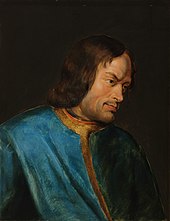
Lorenzo succeeded his male parent, Piero. Lorenzo, every bit heir, was accordingly groomed by his begetter to rule over Florence.
Lorenzo was the greatest creative patron of the Renaissance.[38] He patronised Leonardo da Vinci, Michelangelo and Botticelli, amid others. During Lorenzo's reign, the Renaissance truly descended on Florence. Lorenzo commissioned a multitude of amazing pieces of art and also enjoyed collecting fine gems. Lorenzo had many children with his wife Clarice Orsini, including the hereafter Pope Leo X and his eventual successor in Florence, Piero the Unfortunate.
Lorenzo's brother Giuliano was killed before his own eyes in the Pazzi conspiracy of 1478. This plot was instigated by the Pazzi family. The coup was unsuccessful, and the conspirators were executed in a very vehement fashion. The scheme was supported by the Archbishop of Pisa, Francesco Salviati, who was besides executed in his ceremonial robes. News of this sacrilege reached Pope Sixtus Iv (who had besides supported the conspiracy against the Medicis). Sixtus 4 was "outraged" and excommunicated everyone in Florence. Sixtus sent a papal delegation to Florence to abort Lorenzo.[39] The people of Florence were plainly enraged past the Pope'due south actions, and the local clergy too. The populace refused to resign Lorenzo to the papal delegation. A war followed, which lasted for 2 years until Lorenzo tactfully went nigh diplomatically securing a peace.[40] Lorenzo died in 1492 and was succeeded by his son Piero.
Piero 'the Unfortunate' [edit]
Piero ruled Florence for a mere two years.[41] Charles VIII of French republic invaded Italian republic in September 1494. He demanded passage through Florence to Naples, where he intended to secure the throne for himself. Piero met Charles at the fringes of Florence to try and negotiate. Piero capitulated to all Charles' demands, and upon arriving back in the city in November, he was branded as a traitor. He was forced to flee the republic with his family.
Savonarola [edit]

After the fall of the Medici, Girolamo Savonarola ruled the country.[42] Savonarola was a priest from Ferrara. He came to Florence in the 1480s. Past proclaiming predictions and through vigorous preaching, he won the people to his cause. Savonarola'southward new regime ushered in democratic reforms. It immune many exiles dorsum into Florence, who were banished by the Medici. Savonarola'southward ulterior goal, however, was to transform Florence into a "urban center of god".[43] Florentines stopped wearing garish colours, and many women took oaths to become nuns.[44] Savonarola became most famous for his "Bonfire of the Vanities", where he ordered all "vanities" to be gathered and burned. These included wigs, perfume, paintings, and aboriginal pagan manuscripts.[45] Savonarola's rule complanate a year later. He was excommunicated by Pope Alexander VI in late 1497. In the aforementioned twelvemonth, Florence embarked on a war with Pisa, which had been de facto independent since Charles 8'southward invasion three years before. The endeavour failed miserably, and this led to food shortages. That, in turn, led to a few isolated cases of the plague. The people blamed Savonarola for their woes, and he was tortured and executed in the Piazza della Signoria by being burned at the pale by Florentine authorities, in May 1498.[46]
16th century [edit]
Piero Soderini [edit]
In 1502, the Florentines chose Piero Soderini as their first ruler for life.[47] Soderini succeeded where Savonarola had failed, when the Secretary of War, Niccolò Machiavelli, recaptured Pisa. It was at this fourth dimension that Machiavelli introduced a continuing army in Florence, replacing the traditional use of hired mercenaries.[42]
Giovanni de' Medici [edit]
Soderini was repudiated in September 1512, when Fundamental Giovanni de' Medici captured Florence with Papal troops during the State of war of the League of Cambrai. The Medici rule of Florence was thus restored.[48]

Holy Roman Emperor Charles V
Presently after retaking Florence, Primal Giovanni de' Medici was recalled to Rome. Pope Julius II had just died, and he needed to be nowadays for the ensuing Papal conclave. Giovanni was elected Pope, taking the proper noun Leo X. This effectively brought the Papal States and Florence into a political union.[49] Leo X ruled Florence by proxy, first appointing his blood brother Giuliano de' Medici to rule in his stead, and so in 1513, replacing Giuliano with his cousin, Lorenzo II de' Medici.[50]
Lorenzo Two'southward government proved unpopular in Florence.[50] According to U.S. President and historian John Adams, "at this time the citizens of the land of Florence were in secret very discontented, considering the Knuckles Lorenzo, desiring to reduce the government to the form of a principality, appeared to disdain to consult any longer with the magistrates and his beau-citizens as he used to do, and gave audiences very seldom, and with much impatience; he attended less to the business of the city, and caused all public affairs to be managed by Messer Goro da Pistoia, his secretary."[l] In 1519, Lorenzo died from syphilis, presently before his wife gave birth to Catherine de' Medici, the hereafter Queen of French republic.[51]
Giulio de' Medici [edit]
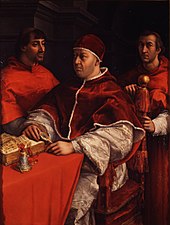
Leo X (middle) and Cardinal Giulio de' Medici (left)
Following the expiry of Lorenzo II, Cardinal Giulio de' Medici governed Florence until 1523, when he was elected Pope Cloudless VII. U.Due south. President John Adams later characterized his assistants of Florence every bit "very successful and frugal."[fifty] Adams chronicles Cardinal Giulio as having "reduced the business of the magistrates, elections, customs of office, and the mode of expenditure of public money, in such a style that it produced a great and universal joy amongst the citizens."[50]
On the death of Pope Leo Ten in 1521, Adams writes in that location was a "ready inclination in all of the primary citizens [of Florence], and a universal desire amidst the people, to maintain the state in the hands of the Cardinal de' Medici; and all this felicity arose from his good authorities, which since the death of the Duke Lorenzo, had been universally agreeable."[l]
When Cardinal Giulio was elected Pope Clement VII, he appointed Ippolito de' Medici and Alessandro de' Medici to rule Florence, under the guardianship of Primal Passerini. [52] Ippolito was the son of Giuliano de' Medici, while Alessandro was allegedly the son of Clement VII. Cardinal Passerini's regency regime proved highly unpopular.[53]
In May 1527, Rome was sacked by the Holy Roman Empire. The city was destroyed, and Pope Cloudless Seven was imprisoned. During the tumult, a faction of Republicans drove out the Medici from Florence. A new wave of Puritanism swept through the urban center. Many new restricting fundamentalist laws were passed.[54]
In 1529, Cloudless Vii signed the Treaty of Barcelona with Charles V, under which Charles would, in commutation for the Pope's blessing, invade Florence and restore the Medici. They were restored after a protracted siege.[55]
"Dukes of the Republic of Florence" [edit]
Following the Republic's surrender in the Siege of Florence, Charles V, Holy Roman Emperor issued a announcement explicitly stating that he and he lone could make up one's mind the government of Florence.[56] On 12 August 1530, the Emperor created the Medici hereditary rulers (capo) of the Republic of Florence.[57] The title "Knuckles of the Florentine Democracy" was chosen because it would eternalize Medici power in the region.
Alessandro de' Medici [edit]

Pope Cloudless VII intended his relative Alessandro de' Medici[a] to be the ruler of Florence, just too wanted to give the impression that the Florentines had democratically chosen Alessandro as their ruler.[57] Even afterward Alessandro'due south accession in 1530 (he reigned equally Knuckles of the Florentine Republic from 1532 on), Purple troops remained stationed in Florence. In 1535, several prominent Florentine families, including the Pazzi (who attempted to kill Lorenzo de' Medici in the Pazzi Conspiracy) dispatched a delegation under Ippolito de' Medici, asking Charles V to depose Alessandro. Much to their dismay, the Emperor rejected their appeal. Charles had no intention of deposing Alessandro, who was married to Charles' daughter Margaret of Parma.
Alessandro connected to rule Florence for another two years until he was murdered on January ane, 1537 by his distant relative Lorenzino de' Medici.
Cosimo I de' Medici [edit]

As Alessandro left no legitimate outcome, the question of succession was open. Florentine authorities selected Cosimo I in 1537.[59] At the news of this, the exiled Strozzi family invaded and tried to depose Cosimo, only were defeated at Montemurlo.[60] Cosimo completely overhauled the bureaucracy and administration of Florence. In 1542, the Regal troops stationed in Florence by Charles 5 were withdrawn.
In 1548, Cosimo was given a part of the Island of Elba by Charles Five, and based his new developing navy in that location.[61] Cosimo founded the port city of Livorno and allowed the city'due south inhabitants to enjoy freedom of religion. In alliance with Kingdom of spain and the Holy Roman Empire, Cosimo defeated the Republic of Siena, which was allied with French republic, in the Boxing of Marciano on August 2, 1554.[62] On April 17, 1555, Florence and Espana occupied the territory of Siena, which, in July 1557 Philip II of Spain bestowed on Cosimo as a hereditary fiefdom.[62] The ducal family moved into the Palazzo Pitti in 1560. Cosimo commissioned the architect Vasari to build the Uffizi, as offices for the Medici banking concern, continuing the Medici tradition of patronage of the arts.
Terminate of the Republic [edit]
In 1569, Cosimo was elevated to the rank of the Grand Duke of Tuscany in 1569 by Pope Pius V. This marks the cease of the Florence Republic, and the beginning of the M Duchy of Tuscany.
Medici dominion continued into the Chiliad Duchy of Tuscany until the family became extinct in 1737.
Administrations of the Republic [edit]
Florence was governed by a council called the signoria, which consisted of nine men. The head of the signoria was the gonfaloniere, who was chosen every two months in a lottery, as was his signoria. To be eligible, one had to accept sound finances, no arrears or bankruptcies, he had to be older than thirty, had to exist a member of Florence's seven main guilds (merchant traders, bankers, two clothe guilds, and judges). The lottery was oftentimes pre-determined, and the results were commonly favourable to influential families.[63] The roster of names in the lottery were replaced every v years.[64]
The main organs of government were known every bit the tre maggiori. They were: the twelve good men, the standard bearers of the gonfaloniere, and the signoria. The first 2 debated and ratified proposed legislation, but could not innovate it. The gonfaloniere'southward initial two month-term in office was expanded upon the fall of Savonarola in 1498, to life, much similar that of the Venetian doge.[65] The signoria held meetings each 24-hour interval in the Palazzo della Signoria. Diverse committees controlled particular aspects of government, e.k. the Committee of State of war. For administrative purposes, Florence was divided into four districts, which were divided into four sub-districts. The master purpose of these counties was to ease the gathering of local militias.[66]
To hold an elective function, one had to be of a family that had previously held office.[47] The Medici family unit effectively ruled Florence on a hereditary ground, from 1434 to 1494, and 1512–1527.
After Alessandro de' Medici was installed as the "Duke of the Florentine Republic" in 1530, in Apr 1532, Pope Clement VII convinced the Balía, Florence's ruling committee, to draw up a new constitution, which formally created a hereditary monarchy. It abolished the age-old signoria (constituent authorities) and the part of gonfaloniere (titular head-of-state elected for a 2-month term) and replaced it with three institutions:
- the consigliere, a four-homo council elected for a iii-month term, headed by the "Duke of the Florentine Republic".
- the Senate, composed of 40-8 men, called by the Balía, was vested with the prerogative of determining Florence's fiscal, security, and foreign policies. Additionally, the senate appointed the commissions of war and public security, and the governors of Pisa, Arezzio, Prato, Voltera and Cortona and ambassadors.[67]
- the Quango of Two Hundred was a petitions courtroom; membership was for life.
Run across also [edit]
- Grand Duchy of Tuscany
- Guilds of Florence
Notes [edit]
- ^ Allessandro is commonly considered an illegitimate son of Lorenzo 2, Duke of Urbino, though some historians advise that Clement himself was the male parent.[58]
References [edit]
- ^ Brucker, Gene A. (1998). Florence: The Gold Age 1138-1737. ISBN0-520-21522-2.
- ^ Najemy. sfnp error: no target: CITEREFNajemy (assist)
- ^ a b c d "History of Florence". Aboutflorence.com. Retrieved 26 May 2009.
- ^ "Florence - Climate". Encyclopedia Britannica . Retrieved 19 October 2021.
- ^ "Renaissance". HISTORY . Retrieved 19 October 2021.
- ^ a b Goudriaan (2018), p. 8-ix.
- ^ Strathern (2007), p. 321.
- ^ See: Jean-Claude Maire Vigueur and Andrea Zorzi ("Il gruppo dirigente fiorentino nell'età consolare" n "Archivio Storico", CLXII (2004), p. 210)
- ^ "Attractions in San Gimignano, Italy". Alone Planet . Retrieved 16 April 2020.
- ^ Bartlett, Kenneth (2005). The Italian Renaissance. Vol. Two. Chapter 7. p. 37.
{{cite book}}: CS1 maint: location (link) - ^ a b Strathern (2007), p. 18.
- ^ Strathern (2007), p. 19.
- ^ Strathern (2007), p. 20.
- ^ Strathern (2007), p. twenty-21.
- ^ Strathern (2007), p. 26.
- ^ Strathern (2007), p. 301.
- ^ a b c Brucker, p. 252
- ^ a b c Najemy, p. 193–194. sfnp error: no target: CITEREFNajemy (assistance)
- ^ Strathern (2007), p. 41.
- ^ a b Strathern (2007), p. 42.
- ^ Strathern (2007), p. 83.
- ^ Strathern (2007), p. 84.
- ^ Strathern (2007), p. 88-89.
- ^ Strathern (2007), p. xc.
- ^ Strathern (2007), p. 94.
- ^ Strathern (2007), p. 106.
- ^ Strathern (2007), p. 117.
- ^ a b Brucker, p. 253
- ^ Najemy, p. 293. sfnp fault: no target: CITEREFNajemy (help)
- ^ Najemy, p. 293–296. sfnp mistake: no target: CITEREFNajemy (help)
- ^ Najemy, p. 296-298. sfnp error: no target: CITEREFNajemy (help)
- ^ Strathern (2007), p. 127.
- ^ Strathern (2007), p. 130.
- ^ Strathern (2007), p. 131.
- ^ Strathern (2007), p. 133.
- ^ Strathern (2007), p. 134.
- ^ Strathern (2007), p. 134–135.
- ^ Strathern (2007), p. 145.
- ^ Strathern (2007), p. 161–165.
- ^ Strathern (2007), p. 166–168.
- ^ Strathern (2007), p. 213.
- ^ a b Strathern (2007), p. 257.
- ^ Strathern (2007), p. 220.
- ^ Strathern (2007), p. 223.
- ^ "Archived copy". Archived from the original on 17 May 2008. Retrieved 1 August 2008.
{{cite spider web}}: CS1 maint: archived copy as title (link) - ^ Strathern (2007), p. 226-269.
- ^ a b Strathern (2007), p. 249.
- ^ Strathern (2007), p. 261.
- ^ Strathern (2007), p. 266–268.
- ^ a b c d due east f "The Works of John Adams, vol. 5 (Defense of the Constitutions Vols. Two and III) | Online Library of Freedom".
- ^ "Lorenzo di Piero de' Medici, duca di Urbino | Italian ruler".
- ^ Strathern (2007), p. 292.
- ^ "Alessandro | knuckles of Florence".
- ^ Strathern (2007), p. 308–309.
- ^ Strathern (2007), p. 311–315.
- ^ Hale (2001), p. 118.
- ^ a b Hale (2001), p. 119.
- ^ Fletcher (2016), p. sixteen,280-81.
- ^ Langdon (2006), p. 34.
- ^ Landon (2013), p. 74.
- ^ Hattendorf & Unger (2003), p. 172.
- ^ a b van Veen (2013), p. 190.
- ^ Strathern (2007), p. fifteen.
- ^ Hale (2001), p. 17–18.
- ^ Strathern (2007), p. 235.
- ^ Hale (2001), p. 15–sixteen.
- ^ Unhurt (2001), p. 121.
Sources [edit]
- Crum, Roger J.; Paoletti, John T., eds. (2008). Renaissance Florence: A Social History. Cambridge University Press.
- Fletcher, Catherine (2016). The Blackness Prince of Florence: The Spectacular Life and Treacherous World of Alessandro de' Medici. Bodley Head.
- Goudriaan, Elisa (2018). Florentine Patricians and Their Networks: Structures Behind the Cultural Success and the Political Representation of the Medici Court (1600-1660). Brill.
- Hale, John Rigby (2001) [1977]. Florence and the Medici . ISBNone-84212-456-0.
- Hattendorf, John B.; Unger, Richard W., eds. (2003). War at Body of water in the Heart Ages and the Renaissance. The Boydell Press.
- Landon, William J. (2013). Lorenzo di Filippo Strozzi and Niccolo Machiavelli. University of Toronto Press.
- Langdon, Gabrielle (2006). Medici Women: Portraits of Power, Love and Betrayal from the Court of Duke Cosimo I. Academy of Toronto Press.
- Najemy, John M. (2006). A history of Florence 1200-1575. ISBN978-1-4051-1954-2.
- Strathern, Paul (2007) [2003]. The Medici: Godfathers of the Renaissance. p. 321. ISBN978-0-099-52297-3.
- van Veen, Henk Th. (2013). Cosimo I De' Medici and His Self-Representation in Florentine Fine art and Culture. Cambridge Academy Press.
External links [edit]
- Pbs.org: Medicis and the Republic of Florence
- The Florentine school of the Renaissance
Source: https://en.wikipedia.org/wiki/Republic_of_Florence
Belum ada Komentar untuk "How Did Lorenzo Save the Family From Disaster That August on the Road to Florence"
Posting Komentar